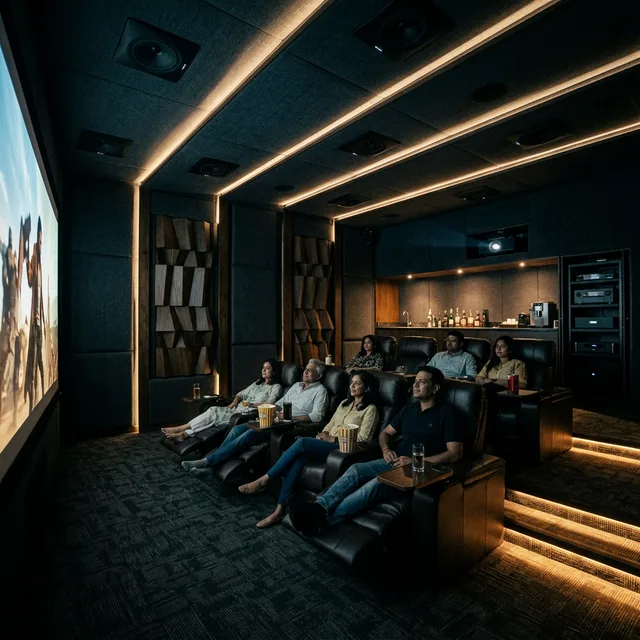
A dedicated private cinema is engineered to reproduce film soundtracks with cinematic dynamics and spatial accuracy. Unlike standard living room media spaces, a purpose-built cinema room coordinates architectural isolation, acoustic wall treatments, speaker geometry, laser projection, and calibrated DSP processing into a unified entertainment environment.
At Synchronos Living, our audio-visual engineers design dedicated cinema spaces for villas and residences across South India. If you are planning a dedicated space, explore our custom home theatre design and installation services in Bengaluru.
Understanding object-based audio in Dolby Atmos
Traditional surround sound formats (such as 5.1 and 7.1) mix audio into fixed discrete channels. If a sound is routed to the left surround channel, only that speaker reproduces it.
Dolby Atmos operates as an object-based audio platform. Sound engineers treat individual audio elements (such as an aircraft flying overhead or footsteps in an alley) as independent sonic objects placed within a three-dimensional coordinate space. During playback, an AV processor calculates which speakers to activate based on the room's exact speaker layout, creating spatial sound movement across listener-level and overhead ceiling speakers.
To achieve reference Dolby Atmos reproduction, you need an Atmos-encoded source, a compatible multi-channel processor, and a room engineered to support overhead audio dimensions (typically 7.1.4, 7.2.4, or 9.4.6 configurations).
Room selection, aspect ratios, and spatial planning
The physical room is the foundation of any cinema installation. Poor room geometry can create severe acoustic standing waves that no digital equalization can completely fix.
Room dimension ratios
Square rooms (such as 4m × 4m) represent the most challenging acoustic geometry because axial room modes coincide on identical frequencies, causing major bass peaks and nulls. Recommended rectangular room dimension ratios based on acoustic engineering principles (such as Bolt area models) help distribute room modes more evenly:
- Height-to-width ratio of approximately 1:1.6
- Height-to-length ratio of approximately 1:2.2
- Minimum recommended space for a 7.1.4 Atmos setup: 12 ft × 18 ft (approximately 3.6m × 5.5m)
- Recommended dimensions for multi-row tiered seating: 15 ft × 22 ft or larger (approximately 4.5m × 6.7m)
Acoustic isolation and internal room treatment
Acoustic engineering in a private cinema addresses two distinct technical objectives: isolation (soundproofing) and internal acoustic calibration.
Acoustic isolation (soundproofing)
Soundproofing prevents cinema sound from disturbing adjacent living areas while blocking external street noise from entering the theatre:
- Decoupled wall construction: Double-stud or staggered-stud drywall assemblies separated by air cavities and dense insulation break mechanical sound paths.
- Vibration mitigation: Resilient channels, acoustic underlays, and specialized damping compounds reduce structure-borne low-frequency vibrations caused by high-output subwoofers.
- Acoustic doors and perimeter seals: Solid-core doors fitted with compression seals and automatic drop seals prevent sound leakage through doorway gaps.
- HVAC duct baffles: S-bend ductwork and inline silencers reduce airflow noise while preventing acoustic leakage through air conditioning shafts.
Internal acoustic treatment
Internal treatments manage how sound energy behaves inside the room after leaving the speakers:
- Corner bass traps: High-density acoustic absorbers positioned in room corners to attenuate low-frequency standing waves below 200 Hz.
- Absorption panels: Positioned at primary reflection points on side walls and ceilings to control flutter echoes and manage reverberation time (RT60).
- Diffusion panels: Quadratic residue or 2D diffusers placed along the rear half of the room to scatter acoustic energy without over-damping the space, maintaining natural ambient spaciousness.
- Target reverberation time: While professional designs often aim for mid-band reverberation times (RT60) between 0.2 and 0.4 seconds, actual acoustic response varies with room volume, furnishings, and boundary materials.
Speaker layout configurations
Dolby specifies detailed placement angles for listener-level and height speakers to guarantee spatial continuity:
7.2.4 layout architecture
- Front stage (3 channels): Left, Center, and Right speakers positioned behind an acoustically transparent projection screen. This aligns speech directly with on-screen actors.
- Surround layer (4 channels): Two side surrounds positioned at 90 to 110 degrees from the primary listening position, and two rear surrounds positioned at 135 to 150 degrees.
- Height layer (4 channels): Four in-ceiling or architectural height speakers placed overhead in front of and behind the primary seating row.
- Subwoofer deployment (.2 channels): Two subwoofers placed at opposing wall boundaries to balance room modes and provide uniform bass across listening seats.
High-performance architectural speaker lines commonly specified for private cinemas include Focal 1000 Series, Bowers & Wilkins CI Series, Krix Dedicated Home Cinema, and Klipsch Real Cinema arrays.
Projection systems and screen technology
In dedicated dark-room cinemas, a 4K laser projector paired with an acoustically transparent fixed-frame screen provides the most authentic cinematic presentation.
Display considerations
- Acoustically transparent screens: Micro-perforated or woven fabrics allow sound from the center speaker to pass through with minimal acoustic attenuation, avoiding dialogue displacement below the screen.
- Solid-state laser projectors: Modern laser projection engines (such as Sony SXRD, JVC D-ILA, and Epson Pro Cinema series) deliver high contrast, wide color gamut coverage (DCI-P3), and solid-state light engines where operational lifespans vary by manufacturer, chassis model, and laser power settings (often specified up to 20,000 hours under standard operating conditions).
- Ambient light control: Dark matte finishes on walls, ceilings, and carpets prevent stray light reflections from washing out projection black levels.
Processing, amplification, and digital room correction
The AV processor acts as the central decoding and calibration engine:
- Channel capacity: A dedicated cinema processor needs sufficient discrete decoding channels to process heights and independent subwoofer outputs (minimum 11.2 channels for a 7.2.4 room).
- Dirac Live and digital calibration: Multi-point microphone calibration analyzes impulse response and room reflections, applying finite impulse response (FIR) filters to smooth acoustic transitions across listening positions.
- Power amplification: High-current multi-channel power amplifiers ensure clean headroom during explosive soundtrack dynamics without harmonic distortion.
Lighting, civil integration, and control
A refined private cinema incorporates practical architectural details:
- Tiered seating risers: Elevated platforms for rear seating rows engineered to preserve direct visual sightlines to the entire screen.
- Low-glare step lighting: Concealed LED pathway fixtures illuminate walkways without reflecting off the screen during playback.
- Unified automation: A single handheld remote or touch panel coordinates room lighting, motorized blackout shades, AV processor power, and media streaming.
Planning a dedicated screening room or villa private cinema? Plan your private cinema with our AV engineering team to review room layouts and acoustic specifications.
Frequently asked questions
Can a dedicated home theatre be built inside an apartment?
Yes, provided structural and acoustic isolation is engineered early in the project. Installing decoupled secondary walls, acoustic door seals, and specialized floor damping significantly attenuates sound transmission, though extreme low-frequency isolation remains constrained by building structure.
How long does a turnkey home theatre installation take?
A complete dedicated cinema installation typically requires 4 to 8 weeks, encompassing civil framing, conduit pulls, acoustic panel fabrication, fabric stretching, equipment rack assembly, and digital calibration.